Please complete the form to apply for a free scan account. We'll get back to you as soon as possible.
Thank you! Your submission has been received!
Oops! Something went wrong while submitting the form.
Turaco Labs needs the information provided to contact you about our services.
Blog
Shopify and the Malware App-ocalypse Clean Up
Turaco Labs
November 20, 2026
3 mins
Tags:
eCommerce
Malware
Web Security
With so much talk lately about AI-driven threats, we've been watching our global ThreatScape data closely. Sure enough, malware detections surged in October. They just didn't surge where most of the market expected.
A surge in an unexpected place
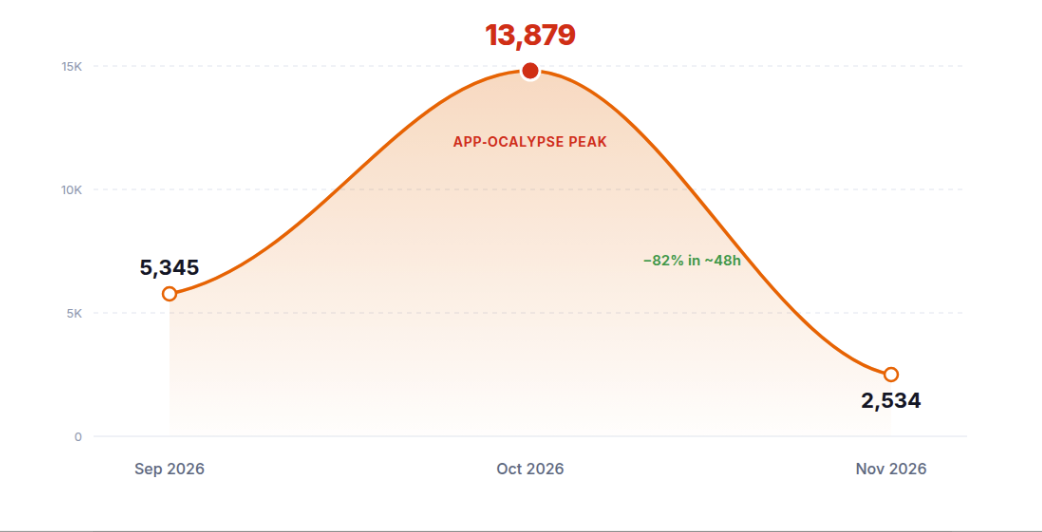
The malware spike showed up on monitored Shopify sites. Malware detections on monitored Shopify sites rose from 5,345 in September to 13,879 in October, approaching 3x the previous month's level. Over that period, Shopify was one of the leading platforms globally for malware infections.
We weren't the only ones to notice. A few quick searches showed that others in the industry were seeing the same pattern, and the incident picked up a nickname: the "Shopify App-ocalypse". We put out an alert to our ecosystem partners so they could check the stores in their portfolios.
Then came the good news
Shopify then appeared to make a significant effort to remove malware from its app ecosystem. By early November, malware on monitored Shopify sites had fallen from October's 13,879 to 2,534, an 82 per cent drop, with most of the decline seen between 28 and 30 October.
Action at that speed and scale is hugely encouraging, and Shopify deserves real credit for taking decisive and serious action.
What this tells us
A few points stand out for merchants, agencies and anyone responsible for a portfolio of eCommerce sites:
Risks can shift to an unexpected part of the stack. Hosted platforms are not automatically out of scope. Third-party apps and integrations can widen the attack surface, even when the core platform is well run.
The picture can change in days. Detection levels can rise significantly in a month and fall by around 80 per cent within days. A monthly or quarterly check could miss most of a swing like this.
Ongoing visibility still matters. Continuous monitoring is how you spot a surge early, warn the people who need to know, and confirm when the risk has eased. That is the reminder from this incident for eCommerce websites, and for those who work with eCommerce portfolios.
Keep watching
Threats can move quickly, which is why the recent focus on AI-driven attacks has been hard to ignore. Ongoing monitoring of your stores, and prompt action on alerts, remains an important way to stay ahead.
ThreatView has started to see a fresh rise in Shopify malware detections in recent days. We're monitoring it, and we'll share what we find.
If you'd like to know how your portfolio risk looks using ThreatView, get in touch.
Well played, Shopify.
Read Other Blog Articles
PrestaShop skimming activity accelerates
Turaco Labs
July 27, 2026
4 mins
eCommerce
Based on the trends identified by ThreatView on the escalation in PrestaShop attacks the past month has brought a sharp inflection in both skimmer detections and overall malware prevalence on compromised PrestaShop storefronts.
Digital Skimmer Targeting Is Shifting: What the Last 3 Months Tell Us
Turaco Labs
June 17, 2026
3 mins
eCommerce
Malware
Web Security
Over the last three months, the digital skimmer landscape has changed noticeably. Based on the latest ThreatView charts, Magento 2 remains the most targeted platform, but the biggest movement is elsewhere: Shopify has risen sharply and now appears to be the second most targeted platform for digital skimmers.
PrestaShop Attacks Are Escalating - What We’re Seeing and What Merchants Should Do Now
Turaco Labs
June 3, 2026
4 mins
eCommerce
Cybersecurity
Malware
In February 2026, we detected 327 compromised PrestaShop websites running card-harvesting malware loaders or digital skimmer malware. By the beginning of June 2026, that number had risen to 1,068. This is an active, expanding campaign affecting a growing number of merchants.